Blog
Oil Stains on Concrete: How to Actually Remove Them
Pressure washing often makes an oil stain look better.
Then the driveway dries. A dark ring comes back.
That isn’t because the pressure washer “didn’t work.” It’s because pressure and water usually remove the surface film first. The oil underneath is still sitting in the concrete’s pores.
Oil stain removal on concrete takes more than pointing a wand at the darkest part of the driveway. It takes the right cleaner, enough time for that cleaner to work, agitation, and a controlled rinse.
We do one thing. We clean driveways. So we’ll give you the honest answer: many oil stains can be lightened substantially, but old or deep stains may not vanish completely.
Concrete Holds Oil Below the Surface
Concrete looks solid. It isn’t.
The surface contains small pores and capillaries that absorb water, oil, transmission fluid, and hydraulic fluid. A fresh spill may sit on top for a while. If it remains there, gravity and time pull it deeper.
The stain you see is not always the full stain.
A pressure washer can remove:
Dirt sitting on top of the concrete
Grease and oil residue on the surface
Loose grime around the edges of the stain
Some of the oil near the top of the pores
That can create a clean-looking patch for a short time. After the concrete dries, oil from deeper in the slab can migrate back toward the surface.
Pressure removes material. It does not automatically dissolve oil.
Hot water helps because it makes oil less viscous and improves the performance of many degreasers. But hot water and pressure alone still may not reach an old stain deeply enough.
The chemistry matters.
Concrete Network explains the role of cleaning chemicals in concrete cleaning here.
Motor Oil, Transmission Fluid, and Hydraulic Fluid Aren’t Identical
They’re all difficult. They don’t all behave the same way.
Motor Oil
Motor oil is usually thick and contains additives. Older motor oil can oxidize and leave behind a sticky, dark residue. A fresh drip may respond fairly well to absorbent material and degreaser. A stain that has sat through several seasons is a different job.
Transmission Fluid
Transmission fluid is often thinner and may spread farther before you notice it. That can make the visible stain look larger than the original spill. It can also soak into more of the surrounding concrete.
Hydraulic Fluid
Hydraulic fluid can leave a dark, oily mark that looks similar to motor oil. Equipment leaks may also create repeated stains in the same area. If the source is still leaking, cleaning the driveway is only a temporary fix.
For all three, the basic approach is similar:
Remove as much loose oil as possible.
Apply a suitable degreaser.
Give it time to work.
Agitate the stain.
Rinse with controlled pressure.
Let the concrete dry before deciding whether another treatment is needed.
The age and depth of the stain matter more than the name on the fluid container.
Dish Soap Is Not a Complete Oil-Stain Solution
Dish soap is made to break up grease on dishes. That doesn’t make it the right product for a porous concrete driveway.
A soap-based “driveway cleaner” may loosen the top layer of oil. Without enough dwell time, agitation, and rinsing, it can also move the oil around. You may end up with a larger, lighter-looking shadow instead of a removed stain.
The same thing happens when someone sprays cleaner on a dry driveway, waits thirty seconds, and immediately pressure washes it.
The cleaner didn’t have time to do much.
A concrete-safe degreaser needs time to penetrate and emulsify the oil. Dwell time is part of the cleaning process, not wasted time.
Lighter stains may need only several minutes. Older stains often need longer and may require another treatment.
The cleaner should stay wet while it works. If it dries in the sun, it stops working properly and may leave its own residue.
What We Actually Do
Our oil-stain treatment is not complicated. It is just more deliberate than pressure washing straight down into the mark.
1. We Inspect the Stain First
We look at the age, size, location, and surrounding concrete.
We also check for:
Cracks and damaged edges
Previous coatings or sealers
Areas where oil may still be leaking
Drainage and runoff concerns
Differences in color between the stained and unstained concrete
A previously sealed surface can respond differently from bare concrete. A deep stain may have been trapped under an old coating.
We won’t promise the same result for every driveway because the surface conditions are not the same.
2. We Pre-Treat With Degreaser
We apply a concrete-safe degreaser to the oil stain and the area around it.
The goal is to break the bond between the oil and the concrete. This is the step that pressure washing alone skips.
3. We Allow Proper Dwell Time
We let the cleaner sit long enough to work. The exact time depends on the product, temperature, and severity of the stain.
We don’t walk away and let it dry. If the cleaner starts drying, we re-wet the area or work in a smaller section.
4. We Agitate the Stain
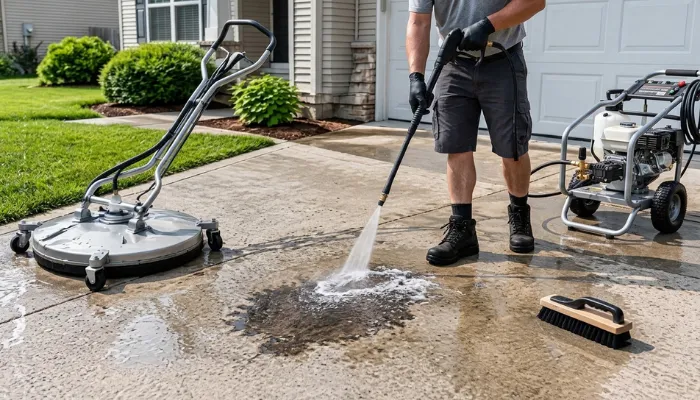
Agitation helps the cleaner reach the pores. That may mean working the area with the proper brush or equipment before rinsing.
This is where a quick rinse and a real treatment start to separate.
5. We Surface Clean and Rinse
Once the oil has been loosened, we use controlled pressure and surface-cleaning equipment to remove the suspended oil and cleaner from the concrete.
We don’t hold a pressure-washer nozzle in one place and blast straight down into the stain. That can etch or mark the concrete without solving the deeper problem.
What You Can Try Yourself
DIY driveway cleaning can work well on a fresh spill or a light, recent stain. Start with the least aggressive method that makes sense.
Step 1: Absorb Fresh Oil First
Cover the spill with cat litter, oil absorbent, or another dry absorbent material.
Let it sit long enough to pick up the loose oil. Then sweep or scoop it up and dispose of it properly.
Don’t immediately add water. Water can spread oil across a larger area.
Step 2: Apply a Concrete-Safe Degreaser
Choose a product labeled for concrete, oil, or grease.
Apply it beyond the visible edge of the stain because the oil may have spread below the surface.
Step 3: Give It Time
Follow the product instructions.
In many cases, five to fifteen minutes is a reasonable starting point.
Do not let the degreaser dry. Work in a smaller area, or apply more product if the surface starts drying in the sun.
Step 4: Scrub
Use a stiff nylon brush.
Scrub the stained area without grinding loose material into the concrete.
Step 5: Rinse Carefully
Use a pressure washer if you know how to control it.
Keep the nozzle moving. Keep a reasonable distance from the concrete. Avoid concentrating the spray on one small spot.
Let the driveway dry fully before judging the result.
If the stain is still visible, repeat the degreaser, dwell, scrub, and rinse process.
Old stains may need several treatments. Some will remain as a lighter shadow.
What Not to Do
Avoid these common mistakes:
Don’t use bleach as your main oil-removal product. Bleach may affect organic discoloration, but it is not a reliable degreaser.
Don’t use muriatic acid. Acid can damage concrete and does not solve an oil problem.
Don’t use a wire brush. It can scratch the surface and expose aggregate.
Don’t let degreaser dry in direct sun. Dried cleaner can leave residue and will not keep breaking down the oil.
Don’t pressure wash straight down into the stain. Excessive pressure can etch the concrete.
Don’t use dish soap and expect a deep stain to disappear. It may loosen the top layer and spread the rest.
Don’t seal over the stain without cleaning it first. A sealer won’t remove oil. It may make the finished result harder to correct.
For more general guidance on removing embedded oil from concrete, see this Concrete Network guide.
What Result Should You Expect?
We often lighten an oil stain substantially.
We won’t promise that every stain disappears.
The result depends on:
How long the oil has been there
How deeply it penetrated
Whether the spill happened repeatedly
The type of fluid
The age and condition of the concrete
Whether the driveway was previously sealed
How much heat, cleaner, and agitation are available
A fresh spill is the easiest situation.
An old stain that has been driven over, baked in the sun, and exposed to several Ohio winters is harder.
That is not a failure of the cleaning process. It is the limit of what can be removed from the material without damaging the concrete.
How Much Does Driveway Cleaning Cost?
Our posted driveway cleaning starts at $99, including oil-stain pre-treatment.
You can check the current driveway cleaning pricing before booking.
We don’t require a sales visit to give you a price, and we don’t add a sealer or another service because you asked about an oil spot.
No upselling. Ever.
If a stain is too old or too deep for us to promise full removal, we’ll tell you.
You can still book the cleaning, ask questions, or leave the stain alone.
The choice stays with you.
Frequently Asked Questions
1. Will Pressure Washing Remove Oil Stains From Concrete?
Sometimes, but pressure alone usually removes the surface residue rather than the oil inside the pores.
Pre-treatment with degreaser, dwell time, agitation, and controlled rinsing gives you a better chance of removing more of the stain.
2. Is Hot Water Necessary for Oil Stain Removal?
No.
Hot water can help, especially with heavy or older oil. But the cleaner, dwell time, agitation, and rinse technique still matter.
Cold-water pressure washing may improve a stain without removing it completely.
3. Can I Use Cat Litter to Remove an Old Oil Stain?
Cat litter works best on fresh spills. It can absorb loose oil before it soaks in.
It will not pull all the oil from a stain that has been sitting in the concrete for months or years.
4. Can You Guarantee an Oil Stain Will Disappear?
No.
We can often lighten stains substantially, but we can’t guarantee complete removal from old, deep, or previously sealed concrete.
5. Should I Seal the Driveway After Removing an Oil Stain?
Maybe.
Cleaning comes first.
After the concrete is clean and fully dry, we can discuss whether sealing makes sense.
A penetrating sealer can help reduce future water absorption, but it does not erase an existing oil stain.
6. Do You Clean Driveways in Hudson, Ohio?
Yes.
We provide driveway cleaning and sealing in Hudson, Ohio and surrounding areas.
You can also contact us directly if you want to discuss a particular stain before booking.
Clean first. Treat the stain. Expect an honest answer.


Quick Links
Quick Links
Contact us


© Copyright. Hudson Driveway Detailers LLC 2026. 56 Milford Dr. #402 Hudson, OH 44236 All Rights Reserved.