Salt Stains on Driveway: Why Concrete Looks Chalky After Winter
That chalky white film on your driveway after winter usually comes from one of two things:
Residue sitting on the surface
Concrete that is starting to break down
Those are not the same problem.
Loose deicer, salt carried in on tires, and mineral deposits can make a sound driveway look dirty. Actual scaling or spalling means the concrete surface is losing material.
The good news is that you can usually make a useful first check without special equipment.
Start With the Simple Test
Look closely. Then touch the surface.
If the white material wipes away or rinses off, and the concrete underneath is still hard and smooth, you’re probably dealing with surface residue.
If the surface feels sandy, rough, or flaky, and small pieces are coming loose, you may be looking at actual damage.
A Quick Test
Choose a small affected area.
Rinse it with clean water.
Rub the area with a damp cloth or stiff nylon brush.
Let it dry.
Check whether the concrete underneath is still solid.
White residue on a hard surface is usually cosmetic. White residue over a soft, flaking surface is a different conversation.
The White Haze May Be Leftover Salt
Some of the film is simply winter material left behind.
Deicer dissolves into meltwater. That water spreads across the driveway, sits in low areas, and evaporates. It can leave behind a pale film or visible white granules.
Salt and deicer also arrive on your tires. A vehicle can carry residue from the road onto the driveway every time it comes home. The residue collects where tires stop, where water drains, and where puddles evaporate.
This is not another comparison of which deicer to buy. The practical point is simpler:
Whatever was used during winter needs to be removed from the concrete instead of left there until spring.
A fresh-water rinse often handles light residue. Heavier buildup may need brushing, repeated rinsing, and proper cleaning.
Efflorescence Comes From Inside the Concrete
The technical term for the chalky mineral bloom is efflorescence.
Concrete contains tiny pores. When moisture moves through the slab, it can carry water-soluble minerals toward the surface. The water evaporates. The minerals remain behind as a white or grayish deposit.
That is efflorescence.
It is usually a surface appearance problem. It does not automatically mean the driveway is failing. But it does tell you that moisture is moving through the concrete.
You may see efflorescence:
Along cracks and control joints
Near low spots
Where snow piles sat
Around the edge of the driveway
In areas that stay damp longer
Near downspouts or drainage paths
Efflorescence can return after cleaning. That does not always mean the cleaning failed. If moisture is still moving through the slab, more minerals may reach the surface.
Sometimes it needs to run its course.
That is not a satisfying answer. It is the honest one.
Scaling and Spalling Are Actual Damage
Residue sits on top of the concrete.
Scaling removes the top layer of the concrete. You may see shallow peeling, flaking, or small areas where the finished surface has broken away.
Spalling is a more serious form of surface loss. Pieces may break off. The surface can become rough, pitted, and uneven. Aggregate may become exposed.
Common Warning Signs
Sandy material collecting near the driveway
Flakes or chips that brush away
Shallow pits across the driving lanes
Rough patches that feel different from the rest of the slab
Areas where the surface looks scabbed or peeled
Aggregate showing through where the finished surface used to be
A pressure washer cannot put missing concrete back.
Cleaning can remove loose dirt and salt. It can make the condition easier to see. It cannot repair surface loss, structural cracks, or a slab that was poorly placed or cured.
If the surface is already breaking down, a concrete repair contractor may be the right next call. We’d rather say that than sell you a sealer and pretend it fixes missing concrete.
How to Remove the Residue
1. Start With Clean Water
For fresh salt residue, use a garden hose with enough flow to move the dirty water away. Don’t just wet the driveway and leave the dissolved salts sitting in another low spot.
Work from the higher part of the driveway toward the drainage point.
Avoid sending concentrated runoff into a neighbor’s yard or toward a foundation. Where the water goes still matters.
2. Brush Stubborn Deposits
Use a stiff nylon brush on areas that remain chalky after rinsing.
Avoid aggressive metal brushes. They can scratch some surfaces and leave behind metal marks. They also don’t solve the moisture problem that caused the efflorescence.
Sweep or rinse away the loosened material.
3. Rinse Again
Efflorescence may take more than one rinse. The first cleaning can remove the minerals already sitting on the surface. A later rinse may remove new material that appears as the slab continues to dry.
This is normal.
It also explains why a driveway can look clean for a short time and then develop another pale haze.
The minerals were not necessarily created by the cleaning. They were already moving through the slab.
4. Use Professional Cleaning When Residue Is Mixed With Grime
Salt residue rarely arrives by itself.
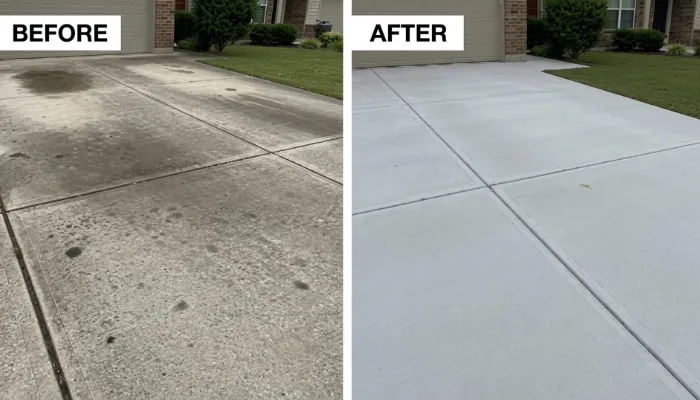
After winter, most driveways also have road film, tire marks, algae, leaf stains, and sometimes oil. A clean water rinse may remove the white film but leave the darker contamination behind.
Our process uses pretreatment and even pressure to clean the driveway without relying on one aggressive blast from a wand. That matters because inconsistent pressure can leave stripes, while too much pressure can roughen an already weakened surface.
Professional driveway cleaning in Hudson, Ohio is not just about making the concrete look lighter. It is about removing the material that should not be there and seeing the actual condition of the slab.
That includes oil stain removal from concrete where the stain is still treatable. We won’t promise every old oil mark disappears completely. Some oil has had years to migrate into the concrete.
Don’t Seal a Damp, Dirty, or Blooming Driveway
Sealing too early is a common mistake.
A penetrating sealer needs clean, reasonably dry concrete. If the slab is still holding moisture, still producing heavy efflorescence, or still covered with salt and grime, sealing may not solve the problem.
It can also make it harder to understand what is happening beneath the surface.
The Right Sequence Is:
Remove loose debris and winter residue.
Clean the driveway.
Inspect for scaling, spalling, cracks, and drainage problems.
Allow the concrete to dry.
Recheck the surface.
Seal only if the concrete is a suitable candidate.
A sealer is maintenance. It is not a repair coating.
What Our Sealer Does, and What It Does Not Do
We use a penetrating silane/siloxane sealer.
It does not form a glossy layer on top. It soaks into the concrete and reduces water absorption inside the slab.
What You May Notice
Water beads instead of soaking in as quickly
The concrete is less likely to darken immediately when wet
Future cleaning may be easier
Less water can enter through the surface
What You Should Not Notice
No glossy shine
No artificial color change
No slippery film
No peeling coating
That is intentional.
A penetrating sealer can help reduce moisture and salt absorption. It cannot stop every efflorescence recurrence. It cannot reverse scaling. It cannot repair cracks. It cannot make an old oil stain disappear by itself.
We use it when the driveway is clean, dry, and sound enough for sealing to make sense.
When to Clean and When to Call Another Trade
You Can Handle Light Residue Yourself If:
The concrete is hard and smooth
The film rinses away
There is no visible surface loss
Drainage is reasonable
You have a safe place for the rinse water to go
Consider Professional Cleaning When:
The haze covers most of the driveway
Salt is mixed with algae, tire marks, or oil
You see uneven cleaning from a previous pressure-washing job
You want the slab inspected before sealing
You don’t have the equipment to clean evenly
Call a Concrete Repair Professional When:
The surface is flaking or sandy
Chunks are breaking away
Pits are deep or widespread
Cracks are widening or moving
A section appears unstable or has settled
We clean driveways. We don’t resurface concrete or pretend a sealer replaces missing material.
A Practical Spring Check
After the driveway has had time to dry, check these areas first:
The street end
Tire stopping areas
Low spots
Control joints
The edges near grass
Areas beneath downspouts
Places where snow was piled
If the surface is hard and the white material is gone after rinsing, you’re likely dealing with residue or efflorescence.
If the surface is rough and continues shedding material, cleaning is only part of the answer.
For local pressure washing in Hudson, OH, we’ll clean the driveway, look at the condition, and give you a straightforward answer about sealing. No sales visit is required. Our pricing is posted online, so you can check the numbers before deciding.
Clean the salt. Check the surface. Seal only when it’s ready.